
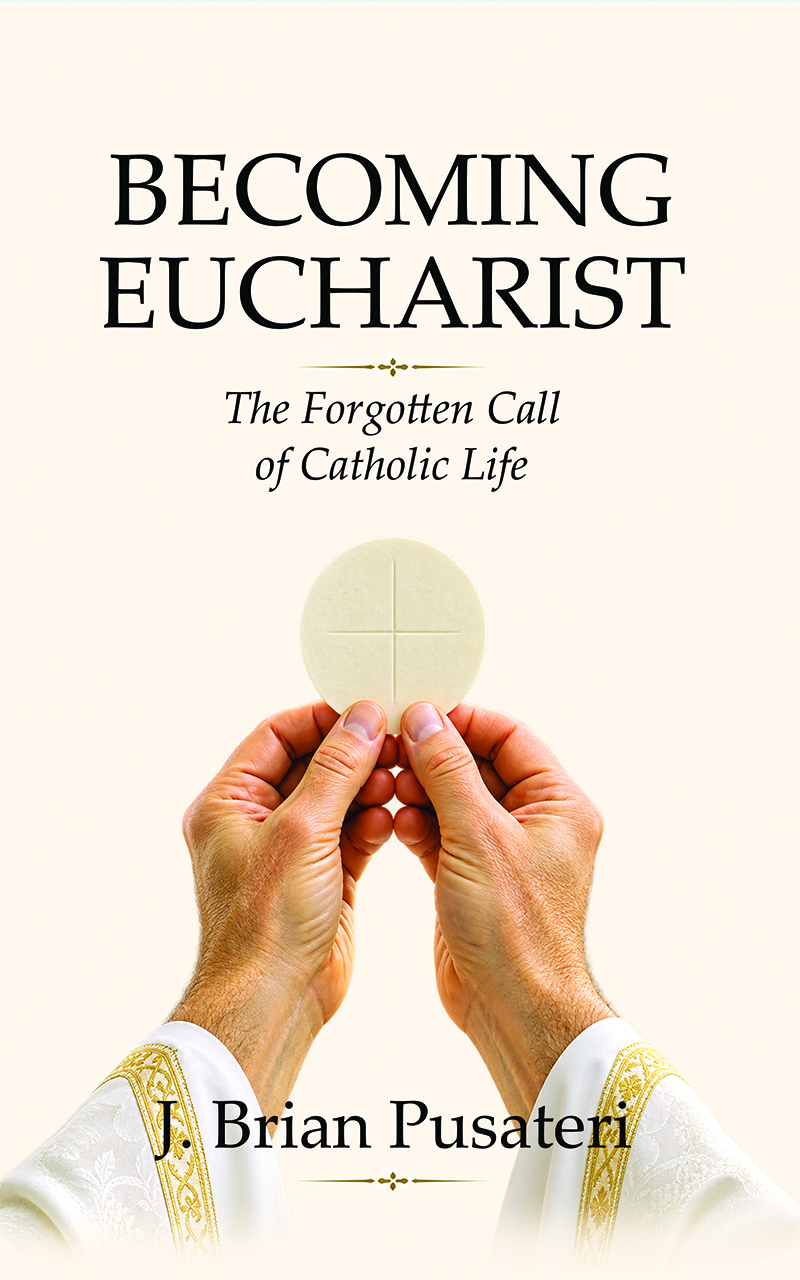
About the Book
Becoming Eucharist: The Forgotten Call of Catholic Life explores an often-overlooked truth of Catholic life: when we receive the Body and Blood of Christ, we are not meant to remain unchanged. Through sacramental grace, we are drawn into deeper union with Christ and transformed more fully into His likeness. Communion is therefore more than something we receive—it is an encounter that changes who we are and prepares us to carry Christ beyond the altar and into the world.
This book invites you to rediscover that forgotten call: not simply to receive the Eucharist, but to become what you receive.

About the Author
Brian is a Christian author and speaker. Brian, a lifelong Catholic, felt his life was forever changed when God spoke to his heart while attending an eight day silent Christian retreat in November of 2011. Soon after that retreat Brian founded 4th Day Letters and Broken Door Ministries. With the God inspired message of mercy and unconditional love that was placed on his heart during that retreat, Brian has been impacting others all over the country and around the world with his weekly letters, his talks, and his all-day Christian retreats. Brian’s life was again impacted in a very dramatic way in June of 2014 when he temporarily lost his eyesight and was diagnosed with a very rare incurable neurological illness, MOG Anitbody Disease. This health challenge has only served to draw Brian closer to God and bolster the importance of this timely yet ageless message.
What People Are Saying
“The author has produced a timely and uniquely insightful monograph on the great mystery of our faith (mysterium fidei): the Most Blessed Eucharist. The book is a joy to read, has sound doctrine, and very relevant practical applications for people in all walks of life. Alternating analysis and synthesis, the perennial truths of the Eucharist are presented in a clear, well-referenced way, while simultaneously challenging the reader to undertake the mission that gives the book its provocative title. What I found noteworthy, and refreshing is the delicate balance presented between theory and praxis; doctrine and mission; interior piety and exterior action; the reverence for the mystery and the clarity of the call to live it and share it. Where many others have failed in this balance by giving us insipid activism or unfruitful pietism, the author enlightens the mind and kindles the heart, challenging both to grow in knowledge and love of the Blessed Eucharist, our true Bread of Life. I pray many people will read this book and be inspired to recognize in their lives the rhythm of being taken, blessed, broken and shared, in union with Christ, for the life of the world.”
—Fr. Andres F Gutierrez
“This book offers a rich reflection on the Eucharist – deeply profound in content, yet readily approachable in style. Drawing on the boundless imagery of the Last Supper, it explores and reminds us of the call to become what we receive in Holy Communion. Embracing the truth of the real presence on the altar, this book challenges the reader to ignite a lived reality of Eucharistic transformation post-consecration. Solidly grounded in church teaching and carrying nihil obstat and imprimatur endorsements, it is a clear and compelling reminder that the Eucharist continues in the mission of the believer beyond the altar.”
—Robert Lange
Chapter 1(excerpt)
The Real Presence — And the Real Absence
Before we begin, let me make something clear about the book you’re holding. This is not a scholarly treatise meant for theologians to debate in seminaries or for Church historians to footnote in academic journals. Popular Catholic voices like Bishop Robert Barron and Father Mike Schmitz, previous Popes like Pope Benedict XVI, and countless theologians through the years—have spoken and written powerfully about the mystery of the Real Presence in the Eucharist. Those teachings are beautiful, necessary, and foundational.
This book is different.
It is written for every Catholic communicant—whether you’ve received the Eucharist thousands of times or are preparing for your First Communion. It is written for parish catechists who must teach this mystery in classrooms and OCIA sessions. It is written for priests and deacons who will preach homilies on the Eucharist to people hungry for both truth and transformation. And it is written for anyone who already believes in the Real Presence and wonders, “What happens next?” What happens after we say “Amen” and return to the pew?
The focus here is not to re-prove the doctrine of the Real Presence, but to explore what it means to live it—what it means for that divine Presence to move from the altar into our homes, our workplaces, our neighborhoods, and the hidden places of our hearts. This book is meant to augment and supplement the excellent teaching already available by asking a different question: How does the Presence we receive at Mass become the Presence we bring to the world?
To answer that, we first have to face an uncomfortable truth. As glorious as the mystery of the Eucharist is, many of us—myself included—have at times received Christ without letting His Presence truly change the way we live. And in our wider Church, this gap between belief and transformation has grown into something far deeper than a personal shortcoming.
A Silent Crisis
In every Catholic church across the world, nestled behind the altar or tucked away in a quiet chapel, is the tabernacle. Often gilded in gold or encased in marble, it is easily overlooked by the casual visitor. But for the faithful, it is the heart of the church—the very dwelling place of God. Inside rests a few small hosts, silent and still, but alive with divine fire. This is the Eucharist: not a symbol, not merely a sacred object, but rather Jesus Christ Himself—Body, Blood, Soul, and Divinity.
This belief lies at the very center of Catholic faith. The Catechism of the Catholic Church proclaims it without hesitation: “In the most blessed Eucharist is contained the whole spiritual good of the Church, namely Christ himself.” The Eucharist is “the source and summit of the Christian life,” meaning that everything we do as Catholics should flow from it and return to it. The Eucharist is not a side devotion. It is the axis on which our entire spiritual life turns.
And yet—something is wrong.
According to an August 5, 2019, Pew Research Center study, only 31% of U.S. Catholics believe that during Mass, the bread and wine actually become the Body and Blood of Jesus—despite the Church’s clear teaching on the Real Presence.
The study also revealed significant variation based on age, ethnicity, and practice. For example, Catholics who attend Mass weekly are far more likely to affirm the Church’s teaching, while younger adults report greater uncertainty.
These distinctions highlight not only the urgent need for renewed catechesis but also the potential for deep Eucharistic faith when formation is strong. This is not merely a theological misunderstanding—it is a pastoral crisis. If the Eucharist is truly the source and summit of our faith, and yet most Catholics either misunderstand or reject it, then we must ask ourselves: what exactly are we living?
Why does this crisis exist?
There are many reasons. Inadequate catechesis is part of the problem—generations of Catholics have gone through religious education programs that focused more on morals and behavior than on mystery and sacrament. Cultural secularism plays a role, too—modern life trains us to believe only in what we can see, touch, or measure. And perhaps most tragically, many Catholics have never had a personal encounter with Christ in the Eucharist. They’ve received Him but never recognized Him. Like the disciples on the road to Emmaus, their eyes have not yet been opened in the breaking of the bread.
But there’s a deeper problem—one that affects even those of us who do believe. It’s not just that Catholics disbelieve in the Real Presence. It’s that even those who affirm it often live as though it makes no practical difference. We kneel at the altar, we whisper “Amen,” and then we rise and leave unchanged. We believe He is there, but we act as if He is absent—from our lives, our choices, our priorities, and our world.
This, I believe, is the real absence: not Christ’s absence from us, but our absence from Him. Christ is fully, truly, and sacramentally present in the Eucharist. The question is: are we? Are we truly present to His presence? Are we living as if we have received the divine? Or have we confined our reverence to the sanctuary, while leaving our hearts untouched?
It is entirely possible to affirm the doctrine of the Real Presence and yet remain spiritually disengaged. I know this firsthand. I’m a cradle Catholic who spent twelve years being taught by the Sisters of Notre Dame at St. Paul’s Catholic School in Norwalk, Ohio. I was well formed in the doctrine of the Real Presence, and I have never doubted it—not once. But even with that firm belief, I was never taught that I was called to become Eucharist. That part of the teaching was either missing or assumed, and I missed it entirely.
We can uphold the Church’s teaching with our minds, while leaving our hearts cold, distracted, or compartmentalized. The result is what Pope Benedict XVI once called an “intrinsically fragmented” faith—a Eucharist received but not lived.
This chapter is not a treatise to convince skeptics of the Real Presence. That work has been done beautifully by theologians, mystics, and saints throughout the ages. Instead, this chapter—and this entire book—are written for those who already believe—or want to believe—but have never been taught what belief demands. Because to receive the Eucharist is not simply to be nourished—it is to be called. It is to be sent. It is to become what we receive.
This crisis of faith might seem like a modern phenomenon—but it is not. The mystery of the Eucharist has always demanded radical belief. From the very beginning, Christ’s teaching about His Body and Blood challenged listeners and divided crowds.
If we are to understand why the Eucharist matters so deeply—and why it has always required radical belief—we must return to its roots. The best place to begin is where God first revealed His plan in Scripture, and where Christ Himself spoke words so challenging that they divided His own followers.
Purchase Today!
