

Podcast: Play in new window | Download
Subscribe: Apple Podcasts | RSS
Pride is not always easy to recognize. Most of us can spot someone else’s sins from a mile away. Pride is one sin, however, that often disguises itself as common sense, good judgment, or even righteousness. It can quietly slip into our thoughts while sitting in church, standing in line at the grocery store, or waiting for an appointment at the doctor’s office. Before we know it, we have looked at someone else and thought, “At least I’m not like those people.” Could it be that one of the greatest spiritual dangers we face is hiding in plain sight? I invite you to read more.

Jesus told a parable about two men who went to the temple to pray. One was a Pharisee, respected by the community and known for his religious devotion. The other was a tax collector; a man viewed as dishonest and sinful by nearly everyone around him.
The Pharisee stood confidently before God and prayed, “O God, I thank you that I am not like the rest of humanity—greedy, dishonest, adulterous—or even like this tax collector.” He then proceeded to list his spiritual accomplishments. He fasted. He tithed. He followed the rules.
Meanwhile, the tax collector stood at a distance. He wouldn’t even lift his eyes toward heaven. Instead, he beat his breast and prayed a simple prayer: “God, be merciful to me, a sinner.”
Most of us know how the story ends. Jesus said it was the tax collector, not the Pharisee, who went home justified before God.
The danger of this parable is that we often read it and immediately identify with the tax collector. After all, none of us wants to be the Pharisee. Yet I wonder if Jesus told this story because He knew how easy it would be for religious people to become exactly like the Pharisee without realizing it.
I suspect we have all spoken words similar to the Pharisee at some time.
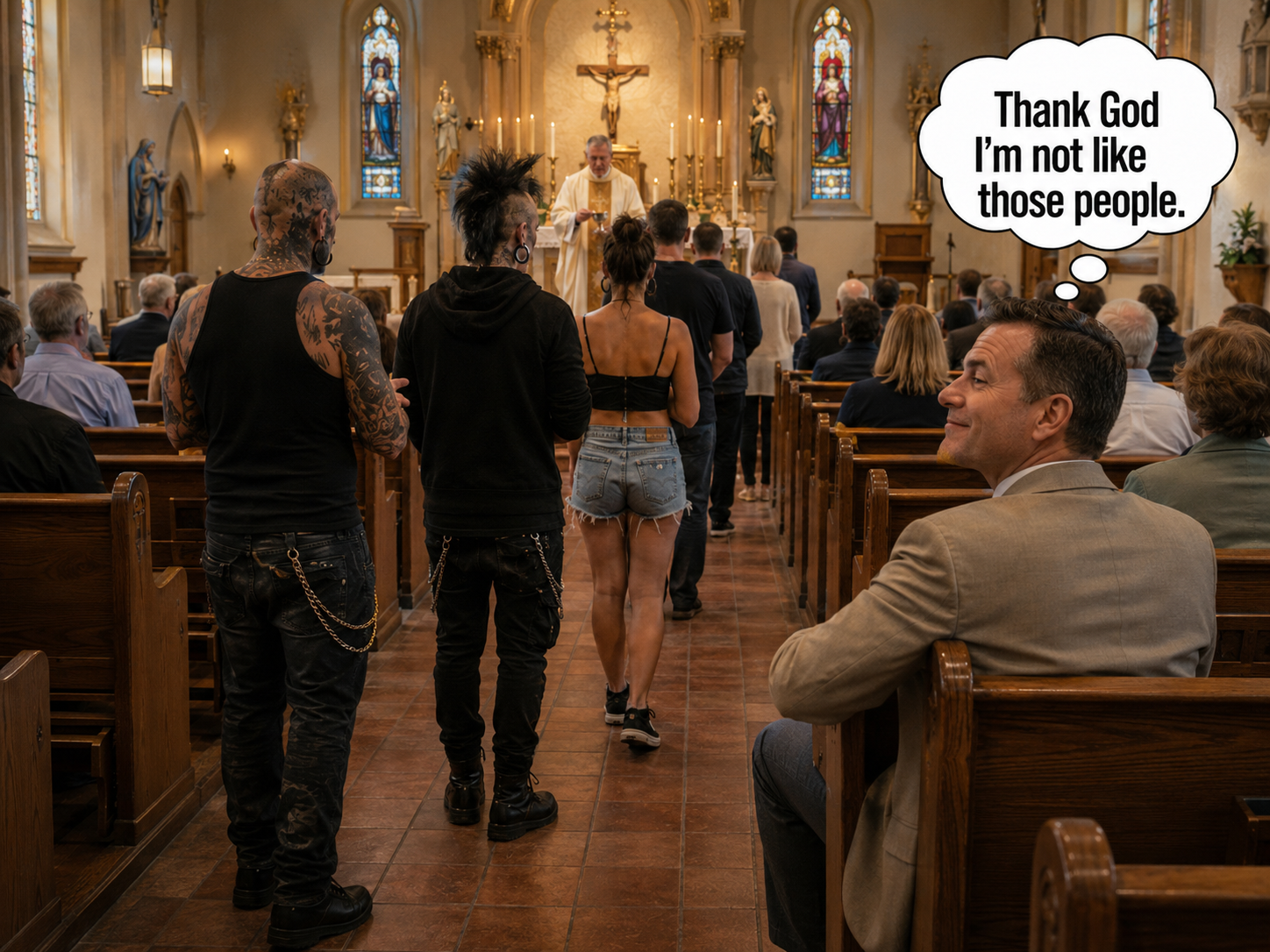
We can be sitting in church, and someone walks in covered in tattoos. Another person has multiple facial piercings. Someone else arrives wearing clothing that seems inappropriate for Mass. Maybe it’s the person with the rough language, the troubled past, or the reputation everyone in town seems to know about. And without saying a word, a thought slips into our minds: “Thank God I’m not like that.”
We may not say it out loud, but we think it. The truth is that every one of us has our own version of “those people.”
Those people are too liberal.
Those people are too conservative.
Those people are illegal immigrants.
Those people are rich.
Those people are poor.
Those people are addicts.
Those people are divorced.
Those people don’t belong here.
The labels change, but the attitude remains the same.
The Pharisee never used the words “those people.” but that is what he meant when he said, “I thank you that I am not like the rest of humanity.” In fact, his entire prayer could be summarized in six words: “Thank God I’m not those people.”
What made the Pharisee’s prayer so offensive to God wasn’t that he fasted or tithed. Those were good things. His problem was that he measured himself against other people instead of measuring himself against God’s holiness. When we compare ourselves to others, we can always find someone who makes us feel superior. There will always be someone with more visible sins, more obvious struggles, or a more broken past. But when we compare ourselves to Jesus, the ground suddenly becomes level.

The reality is that every person sitting in church is broken. Every person standing in the grocery store is carrying wounds we cannot see. Every person sitting in that doctor’s waiting room is fighting battles we know nothing about. The heavily tattooed man may have a deeper prayer life than I do. The woman with the nose ring may trust God more completely than I do. The recovering addict may be far more aware of his dependence upon God’s grace than I am. The person I am tempted to judge may actually be much closer to God than I realize.
One of the beautiful truths of Christianity is that we all come to God the same way—not through our accomplishments, appearance, reputation, or moral scorecard. We come as sinners in need of mercy. The tax collector understood that truth. The Pharisee did not. Every day we are given a choice. We can stand before God listing the reasons we think we are better than someone else, or we can stand before Him with empty hands and humble hearts. Only one of those prayers receives God’s blessing.
So today, perhaps the most important question is not whether we know any Pharisees. The real question is this: Who are “those people” in our life? Because, however we answer that question, may reveal far more about our own heart than it does about theirs.
Heavenly Father, forgive me for the times I have judged others while overlooking my own need for Your mercy. Help me to see people through Your eyes, remembering that every person I meet is someone You love deeply. Give me a humble heart that seeks compassion rather than comparison and remind me daily that I stand before You only because of Your grace. Amen.
Have you checked out my new book, Living Out the Lord’s Supper? To find out what readers everywhere are talking about, click here.
AMDG
AMDG is a Latin abbreviation for “Ad Majorem Dei Gloriam,” which means “For the Greater Glory of God.”
I always love to hear from you. You can email me by clicking here.
Please take a moment to share your thoughts about today’s message below.

- Yesterday’s Crooked Rows - October 23, 2026
- Have We Sanitized Death? - October 12, 2026
- Willing Enslavement - October 5, 2026

I had a humorous take: Thank God I am not an Anaheim Angels fan —one of THOSE people. (Fans of the MLB team who is always in last place)
Then I realized my Baltimore Os are in last place! Are people saying of me: I am sure glad I’m not a suffering fan like THAT guy?!
Proud people like to be associated with being a winner.
A ‘humble’ Orioles fan. JB
John
Your comment sure made me smile.
Brian
Excellent again. I think we’re blessed when we know how much we need God. Reminds me of a story about Honri Nouwen. He was crying in his office one day and his secretary asked why. He said his friend Harry confronted and berated him while walking, telling him he wasn’t being Godly and was too busy all the time and didn’t have time for the friend. He said Harry was right of course and was he feeling sad about it. Then after a few minutes he gathered himself for his next meeting and started to walk out the door. He turned back to his secretary and said. ” I wonder though, if Harry realizes what I would be like without God.”
Paul
Thanks for your post and for sharing the story about Henry Nouwen.
Brian